
The annual American basket-flowers are nearing the end of their cycle. There are still a few stalwarts blooming, but basket-flower foliage is crispy,…
Bumbling in Baskets
The annual American basket-flowers are nearing the end of their cycle. There are still a few stalwarts blooming, but basket-flower foliage is crispy,…
Bumbling in Baskets

Growing your own “Victory Garden” food has traditionally been used as a successful safeguard against food shortages and stretching the family food budget to feed your family.
The practice of starting a “Victory Garden” started in 1943 as a way to help feed the American family to offset food shortages when much of the food supply was being directed to our troops during World War 11.
“We want to give every home-gardener easy access to tomato seeds, an abundant tomato harvest of nourishing fruit, and seeds for the future.”
– Gary Ibsen and Dagma Lacey
One tomato seed can provide you as much as thirty pounds of tomatoes and enough of your own seeds to provide you future crops.
Today, the food supply and health of Americans are facing challenges. As a nation, we do not eat enough fruits and vegetables. To make matters worse, much of our fresh foods travel long distances before they arrive at our homes, thereby losing precious nutrients along the way. A substantial portion of this food is grown with injurious pesticides. The increasing food prices (especially for organic food) only magnifies the problem. It is understandable why home gardening is making a resurgence. We are saving ourselves in the process.
If you do not have much of a yard, do not be deterred from growing a garden. Even an 8′ x 8′ garden can grow lots of food.
1 Growing your own vegetables is a good way to save money.
2 You can avoid eating harmful pesticides
3 Homegrown vegetables provide you more nutrition and flavor.
4 Growing foods from your garden will support opportunities for precious bonding experiences with family and friends.
5 The activity of gardening allows you to control much of your food supply and enhance your self-reliance.
6 Gardening will provide you fresh air, outdoor exercise, a connection with the earth and a joyful sense of purpose.
7 By saving seeds from your harvest you will own the future of your foods rather than depending upon other interests.
8 Gardening is a great activity to help relieve stress and improve restfulness.
9 Responsible gardening can reduce your carbon footprint.
10 All gardeners live longer!
In West Virginia, this insect likely has two generations per year. Adults remain throughout the winter, often seeking shelter in crop residues and other organic debris such as dead leaves, mulch or bunches of grass. Adults begin depositing eggs about two weeks after becoming active in the spring.
Harlequin bugs are in the stink bug family and are black with bright red, yellow or orange markings.
The harlequin bug, Murgantia histrionica, is an insect pest of vegetable crops in the Brassicaceae family . Plants commonly attacked by this insect include broccoli, Brussels sprouts, cabbage, cauliflower, collards, kale, kohlrabi, mustard, radish and turnips.
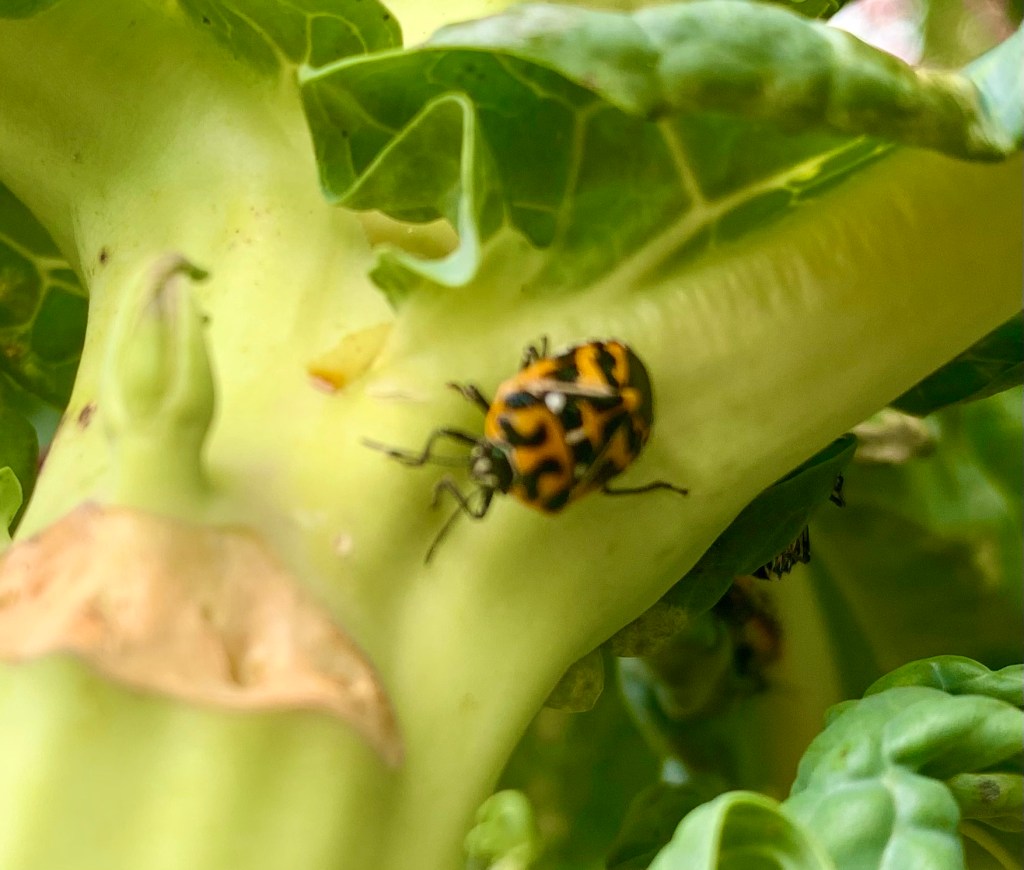
This pest injures host plants by sucking the fluids from plant tissue. This can result in yellow or white blotches at the feeding site and wilted or deformed plants. Heavy infestations can cause plants to turn brown and die.
Cultural and chemical controls can be used to manage harlequin bugs. Destruction of crop residues in the fall is an important cultural practice to limit harlequin bug damage for the following year. Because this insect can also feed and reproduce on wild, weedy mustards (e.g. pepperweed, shepherd’s purse, wild mustard), it is also important to keep weeds under control in fields and along field edges.
In the southern United States where the harlequin bug is a serious pest, trap crops consisting of early planted horseradish, kale, mustard or rapeseed have been used to divert overwintering populations. These crops are then sprayed or destroyed before the primary crop becomes susceptible to attack.
Chemical options for control of harlequin bugs include numerous compounds in the pyrethroid (e.g., beta-cyfluthrin, bifenthrin, lambda-cyhalothrin) and neonicotinoid (e.g., acetamiprid and clothianidin) class of insecticides; pyrethrins are permissible in organic production.
Recently, the harlequin bug has been observed more frequently in the south. Although it is unclear why these insects are becoming increasingly problematic, growers introducing fewer brassica-free periods during the season and/or growers not initiating a strong weed management program may be contributing to its abundance on farms.
Author: Daniel Frank, former WVU Extension Entomology Specialist
 Deltona Garden Community