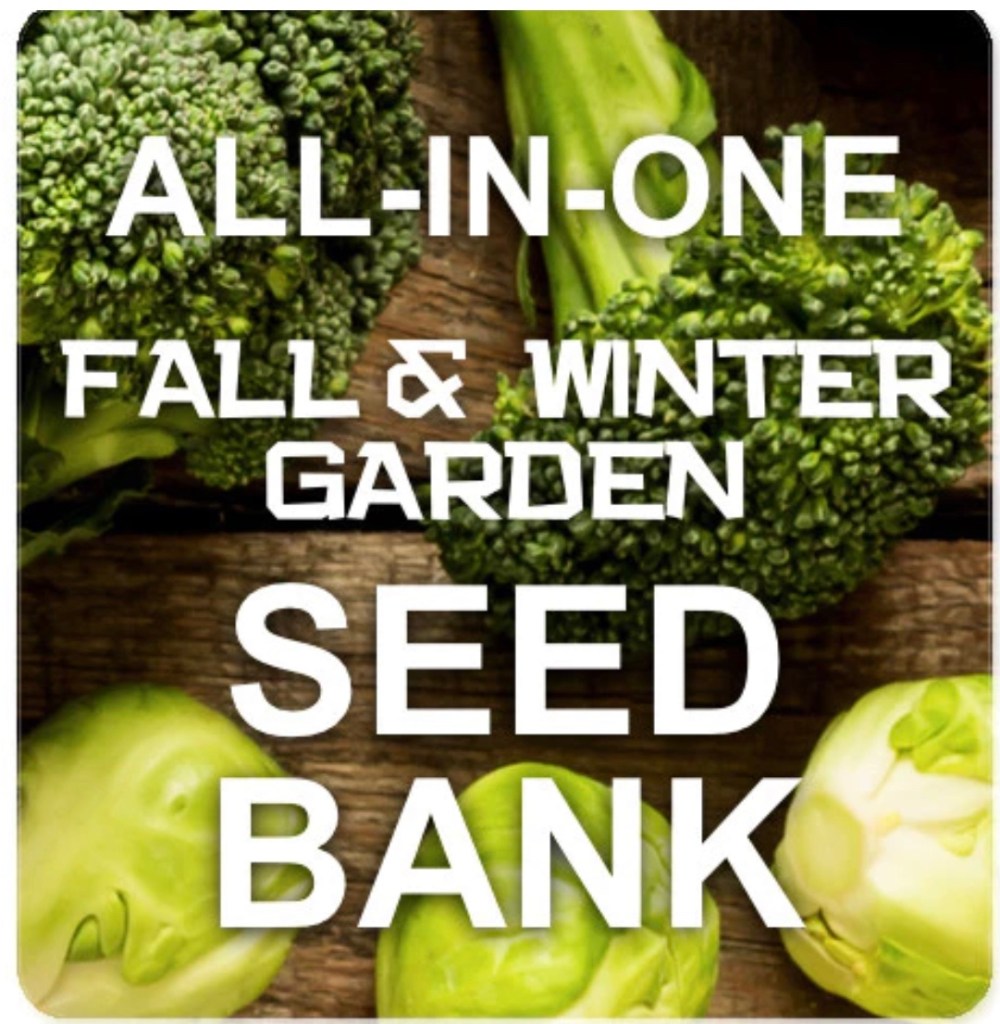
The Fall/Winter Harvest Seed Bank includes a collection of all the seeds you need to grow your favorite fall and winter crops.
Click picture to see all the seeds! 20 varieties of crops (individually packaged)
These seeds thrive in cold weather and are extremely hardy.
You will be able to grow your own brussels sprouts, carrots, kale, broccoli, turnips, swiss chards and so much more. With over 20 popular varieties included, this seed bank is your #1 seed bank of choice for seeds that thrive in cooler temps.
What’s Included?
Over 6,500 seeds in total (all seeds can be saved for multiple planting seasons)
BONUS! We’re including 25 seed starting soil pellets (so you can start your seeds indoors!)
Seeds are individually packaged and labeled in resealable bags and then secured in a Mylar bag (provides two layers of protection from moisture and light)
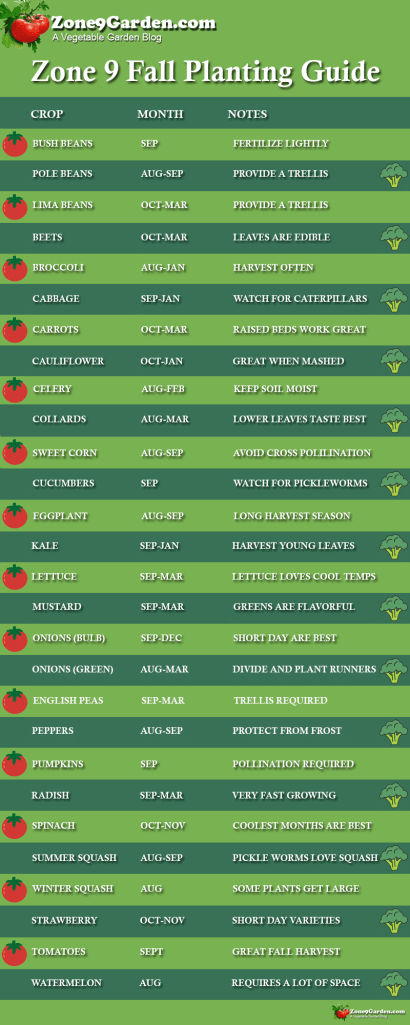
Many of you expressed interest in setting up and growing a vegetable garden this summer.
Most of the vegetables do not like extreme heat. I wouldn’t recommend the mindset of traditional growing seasons if you have never grown in Florida! Planning ahead makes the difference.
It’s not too late to set seeds out or pre-sprout indoors. This list will also work for Jan-Feb planting preparation for spring.
Fall is perfect for all the cool weather loving starts. The daily rain works in our favor if you’d like to try growing a fall garden. Summer requires daily watering and fending off heat loving pests! Everyone deserves a break from the heat!!! So give it a try!
Remember the prices on the produce aisle? That should be motivation enough! The best part is you won’t have to worry about how or where your produce was grown.
If you aren’t really “into gardening” but like a little spice in your life, why not grow some herbs?
Herbs such as oregano, rosemary and basil are great in a planter. They also enjoy a little cool weather. The oregano plant that I have is at least 20 years old! Ah fresh herbs. Just the smell makes me hungry!
Get out there and then you can Mangia Bene! (Eat Well). Ciao (chow?) No….🤪
Plants grow best in specific locations due to the temperature and climate that they can tolerate. Across the country, temperatures can vary significantly from one coast to another, within the same state, or from one state to the next.
When planting flowers it is important for people to understand what grows best where they live and what will likely not thrive at all. For this purpose there is a resource known as the USDA Plant Hardiness Zone Map.
This map vertically divides the country into thirteen zones of hardiness for gardening in winter temperatures. The zones are based on the coldest annual minimum temperatures in a region based on averages over a period of thirty years. Each of the planting zones is numbered, with Zone 1 being the region with the coldest annual temperatures and Zone 13 being the hottest. Each zone on the map is separated by ten degrees Fahrenheit. Additionally, each zone is further broken down into “a” and “b” sub-zones that are divided by five degrees Fahrenheit.
Understanding and following the gardening zones is one of the best ways to ensure a beautiful and healthy garden.
Zone 1
Zone 1 can be found in areas with extreme minimum temperatures of -50 degrees Fahrenheit or lower. Areas within this zone are further divided into 1a and 1b. The temperature range in zone 1a is between -60 and -55 degrees, while 1b is -55 to -50 degrees Fahrenheit. Parts of Alaska, including Bettles and North Slope, are zone 1. Plants such as the quaking aspen, dwarf birch and black crowberry will grow well in zone 1.
Zone 2
Zone 2 is another area with inhospitably cold temperatures, and is mapped with annual cold temperatures between -50 and -40 degrees Fahrenheit. People who live in this planting zone can successfully plant the American elm, American cranberry bush and the silverberry. Some plants do best in one of the specific growing zones. For example, bearberry is most successfully planted in zone 2b where the minimum temperature range is between -45 degrees Fahrenheit and -40 degrees Fahrenheit.
Zone 3
Zone 3 is an area that is known for relatively cold winters and short summers. Plants that can survive temperatures between -30 and -40 degrees Fahrenheit are suitable for this zone. Aster is a flower that will thrive here, as will black-eyed Susans and tulips. Areas in Alaska are zone 3 as are areas in North Dakota, Montana, Minnesota, and Wisconsin. Zone 3 is further divided in half into garden zones 3a and 3b.
Zone 4
This zone ranges from 30 to 20 degrees Fahrenheit with the last frost occurring in early June. Like Zone 3, the winters are cold while the summers are short. Plants that thrive in Zone 4 include the Japanese yew, ginkgo, the Trumpet Honeysuckle, and the Persian violet. Nebraska, Iowa, Illinois, and parts of New York and Maine are all parts of Zone 4.
Zone 5
Zone 5 is found in regions where the last frost occurs in late May and the lowest temperatures are between -20 and -10 degrees Fahrenheit. Sub-zones split these coldest temperatures, with 5a being -20 to -15 degrees Fahrenheit and 5b being -15 to -10 degrees Fahrenheit. Areas within this zone have winters that are cold and windy, and summers that tend to be long. Gardeners who are both casual and professional may plant plants such as the Japanese maple, Japanese holly, the multiflora rose, Shasta daisies, and tulips. Vegetables and fruits that grow well in this zone include spinach, strawberries and tomatoes.
Zone 6
In Zone 6, plants may safely tolerate temperatures of -10 to 0 degrees Fahrenheit. The summer weather conditions in Zone 6 are usually dry and long. The winters are often windy and very cold. This zone nearly bisects the country and is found in states such as New Mexico, Missouri, Illinois, Indiana, Kentucky, Ohio, and West Virginia. Other states including parts of Washington, Oregon, Nevada, Utah, Connecticut, New York, Pennsylvania, and Massachusetts are also Zone 6 to some extent. The last frost in these areas tends to be around mid-May. Plants and flowers that grow well in Zone 6 include the English lavender, purple coneflower, hydrangeas, English yew, English holly, and American holly.
Zone 7
Areas with lowest temperatures between 0 to 10 degrees Fahrenheit are known as Zone 7. Generally the last frost in these areas is in late April. Flowers and plants that thrive in this planting zone include the Kurume azalea, daffodils, crocuses, lilies and pansies. Plants that grow best in sub-zones include chinaberry, Monterey pine, and monkey puzzle, all of which grow best if temperatures reach no lower than 5 to 10 degrees Fahrenheit or 7b. On the map, Zone 7 is found in states that include, but are not limited to, Texas, Nevada, California, Washington, Oregon, and Virginia.
Zone 8
People living in Zone 8 are able to safely plant flowers and other plants that can tolerate low temperatures from 10 to 20 degrees Fahrenheit. People who live in subzone 8a may plant flowers in temperatures as low as 10 to 15 degrees Fahrenheit. People living in zone 8b can plant in minimum temperatures from 15 to 20 degrees Fahrenheit. Zone 8 covers much of the lower half of the U.S. and can be found in states such as California, Nevada, Arizona, Texas, Mississippi, Alabama, Georgia, Florida, and South Carolina, to name a few. Plants and flowers that are suitable for this zone include oleander, Indian azalea, hybrid rhododendron, butterfly blue, and purple-top verbena
Zone 9
Warm weather flowers and plants are suitable for planting in zone 9, where the annual minimum temperature is 20 to 30 degrees Fahrenheit. The gardening zones in zone 9 are zone 9a and 9b. Plants in zone 9a will tolerate minimum temperatures of no lower than 20 to 25 degrees Fahrenheit. In 9b, the lowest temperature for flowers or plants should be 25 to 30 degrees Fahrenheit. Zone 9 occupies most of the lower states including California, Arizona, Texas, and Florida, to name a few. Plants that are well suited for this area include fuchsias, asparagus-fern, Australian pine, and Chinese hibiscus.
Zone 10
Zone 10 gardeners are dealing with warmer temperatures that are not suitable for cold weather plants. The average minimum annual temperatures that plants can safely tolerate in these regions are 30 to 40 degrees Fahrenheit. The two planting zones that make up zone 10 are 10a and 10b. Examples of where these garden zones are found include California, parts of Arizona and East Texas, Louisiana, Florida, and some of the Hawaiian Islands. Bougainvillea, poinsettia, royal palm, and rubber plants all grow well in zone 10.
Zone 11
This is a tropical zone that is found in some areas of Southern California, the Florida Keys, the Hawaiian Islands and Puerto Rico. Annual minimum temperatures are between 40 and 50 degrees Fahrenheit. The growing zones in zone 11 include 11a and 11 b. Geraniums, impatiens, and veronica or speedwell, are flowers that do well within these zones.
Zones 12 and 13
According to the USDA Hardiness Zone Map, these garden zones apply to the Hawaiian Islands and Puerto Rico and are not found on mainland USA. Temperatures for zone 12 are 50 to 60 degrees Fahrenheit. Zone 13 temperatures are 60 to 70 degrees Fahrenheit. Each of the two zones has sub zones that split them by 5 degrees Fahrenheit. Musk okra, caterpillar plant, and knife acacia are flowers that grow in these zones.
Rebecca Finneran is a garden expert, and even she was seduced by the rose campion. Finneran, a senior horticulture educator with the Michigan State University Extension, planted the perennial, known for its gray foliage and magenta blooms, in her home garden.
But it had a mind of its own. “I loved that plant. And I suddenly realized that it was coming up down the hill in the woods from my garden,” she says. “And I would faithfully go down there and dig it up and bring it back. And then I looked out one day and, holy mackerel, there’s hundreds of them.” While the rose campion isn’t technically classified as invasive in Michigan, it’s a plant that can quickly spread, popping up in unwanted places or pushing out other native species. It’s a reminder to gardeners to be responsible for what they plant, Finneran says. That means, for example, avoiding true invasives, monitoring energetic spreaders or non-disease-resistant varieties, and managing plants that can be water hogs or fire risks. “I think gardeners need to better observe what their plants do,” she says. So while it might be love at first sight at the garden center, research whatever you plant to make sure you aren’t introducing a problem like one of the varieties of bamboo that have proven to be invasive in the United States. One of Finneran’s most important garden tools is her phone, which she uses to research cultivars before she buys them to see if they are plants not to plant. What should you be on the lookout for? Here are four categories to help you know:
Invasives For homeowners, super-spreaders like rose campion can be a pain, but invasives are a whole other level of headache. When plants like bush honeysuckle or Mexican petunia escape your garden and intrude on the natural landscape, they displace native species, threaten the ecosystem, affect fire patterns and even change the biochemistry of the soil, says Deah Lieurance, a member of the faculty at the University of Florida and chair of the Florida Invasive Species Council. Florida spends $45 million a year trying to clear conservation areas of invasive species, most of which have been introduced through horticulture, Lieurance says. How do you know if a plant is invasive? County extension agents and master gardener programs have information, and many states have invasive plant councils that assess risks, says Lieurance. Some states, like Massachusetts, maintain a list of banned plants. Last year, the Pennsylvania Department of Agriculture instituted a ban on nurseries and stores selling Bradford (or Callery) pear trees, loved by homeowners and builders for their fast growth and showy flowers. But the trees spread and crowd out other species, grow spurs that make walking through brush difficult, have long taproots that complicate removal and self-destruct after 15 or 20 years, says Theresa Culley, who heads the biological sciences department at the University of Cincinnati and works with Ohio’s Invasive Plants Council. Not all non-native plants are invasive: It’s OK to grow something that doesn’t grow naturally in your area as long as it doesn’t pose a threat, Culley says. But do the research to find out which ones are safe.
Water hogs Depending on where you live or what drought conditions may be in effect, water may be scarce or expensive. It’s therefore strategic to look for plants that require little water or to group water-lovers like astilbe and ligularia in one area of your garden so heavy watering is limited to one spot, says Finneran, who writes about water-smart gardens for Michigan State. Here, too, it pays to research a plant to learn about its native habitat. For example, the red maple is popular with homeowners, but it’s also known as swamp maple, which says a lot about its water needs. “In my world, we’re constantly diagnosing plant problems that we create ourselves because we have one uniform irrigation practice,” Finneran says. “We’re irrigating the plants that hate to be irrigated along with the plants that love to be irrigated.” Also, consider where you place container plants. A container tomato will need more water if it sits in a heat-absorbing location like an exposed deck or a stone patio. Look for plants that fit your conditions and what you can manage, Finneran suggests. “It’s really hard for the beginning gardener because the beginning gardener looks at a magazine and they go, ‘Oh, I want that.’ You just can’t have it all. It’s like buying clothes that don’t fit you.”
Disease spreaders Gardeners tend to design by shape or color, but Finneran advises that you factor in disease resistance or you risk having a weak cultivar that spreads a pathogen like powdery mildew throughout your flower bed. “One of my favorite plants is tall phlox,” she says. “They’re fragrant, they’re colorful, but oh my gosh, some of them are really resistant to powdery mildew, and some of them are terrible.” Her solution? Removing susceptible cultivars from her flower beds and replacing them with varieties that are disease resistant. “Keep in mind that the more disease you allow to be in the garden, the more disease you’ll have,” she says.
Fire risks This winter’s Marshall fire near Boulder, Colorado, which destroyed over 1,000 homes, is a tragic reminder of the increased risk of wildfires, says Christopher Jones, who’s responsible for agriculture and natural resources extension programs at the University of Arizona. The latest strategy for fire safety is to prevent wildfire embers from igniting materials — including plants — around a house, he says. “Now they say no plants within zero to 5 feet of the structure, and we’re recommending that you use containers, things you can move out of the way in case of a fire,” he says. Jones offers presentations on how to be fire wise, and several western state extension services distribute an ember awareness checklist. While no plant species is totally fireproof, deciduous plants tend to be the most fire resistant because the leaves have a high moisture content, he says. That’s opposed to plants that have mechanisms to retain moisture — including conifers, junipers and pines, and arborvitae. “They have needles or scales so they can hold that moisture,” he says. “That’s done because of the oils and resins that are in those needles. The presence of [those oils] just allows them to really burn hot.” Aromatic plants are dangerous, Jones says, since it’s the oils that make them smell so good. Rosemary is one example. “Great, easy plant for us to grow around here,” Jones says, “but if it catches on fire, it’s going to burn very hot.” Even a fire-wise plant can become a problem if it isn’t kept trimmed and free of detritus. “You want to keep them well maintained rather than allowing a lot of dead material to build up around them,” Jones says. Fire risk is yet another reason to avoid invasive plants, Jones says. Buffel grass and red brome, for instance, are range grasses that were introduced into the West and have contributed to wildfires, he says. For more information on how to protect yourself and your property, check with your extension service or fire department
National Garden Clubs, Inc. is a 501(c)(3) organization that aims to promote the love of gardening, floral design, and civic and environmental responsibility and we help coordinate the interests and activities of state and local garden clubs in the U.S. and abroad.
The first garden club meeting in the United States took place in Athens, Georgia in 1891. It occurred during a time when women were seeking knowledge about a variety of subjects in study clubs of those with like interests. They felt they needed more knowledge, as they had not had the benefit of a formal higher education.
The topic of gardening was a logical choice for women in Athens, as it was the site of the University of Georgia with its botanical garden. This garden had a collection of thousands of rare plants. With the failure of the botanical garden, many residents had an interest in exchanging plants among themselves.
The idea to have a garden club came from Dr. Edwin Dorset Newton, an Athens physician who had a keen interest in horticulture. Twelve women met in the home of Mrs. Edwin King Lumpkin on a January day in 1891 to form the Ladies’ Garden Club of Athens. The primary purpose was to study plants with each member studying a particular variety. These members dedicated themselves to the study of horticulture and the exchange of plants and ideas for the betterment of their community. Members were encouraged “to carry out experiments with different vegetables, flowers, seeds and so forth to find out which varieties were best.” The first flower show grew from the exhibitions of their flowers and vegetables.
If you need a quick reference or intro to gardening terms, here’s a basic list.
ANNUALS
Varieties that complete their life cycle in one year or less, requiring sowing every year. Annual flower varieties often bloom profusely and over a long period of time.
BIENNIALS
Varieties, both flowers and vegetables, that complete their life cycle in two years, usually just showing only leaf growth the first year, and flowers the next.
BABY GREENS
Young, leafy vegetables or herbs that are harvested at 2″–4″ tall.
BOLTING
The condition of premature flowering in edible crops, often making the plant unpalatable.
BURPLESS CUCUMBERS
Cucumbers that do not produce, or produce very little of a chemical called cucurbitacin, which produces a slight bitter flavor mainly concentrated in the skin and causes minor indigestion in some people.
COLD CLIMATES
Botanical Interests defines cold climates as those that experience freezing temperatures; generally, USDA zones 9 and cooler.
COLD FRAME
A four-sided frame placed on the ground or in a garden bed that has a clear top. By design, it increases temperatures over the ambient temperature and is used for growing seedlings for transplant or for food crops, extending the harvest season.
COMPANION PLANTING
Planting different plants together that benefit one another. For example, sowing a plant that attracts pollinators next to a plant that requires pollination.
COMPOST
Organic matter often made from decomposed/broken down plant material. Compost can be used to replenish soil nutrients and introduce soil biology to a growing area or simply to reduce landfill waste.
COVER CROP
Fast growing plants, usually grains, legumes, or grasses that are utilized for one or more of their soil-enhancing qualities. These crops are usually worked into the soil or removed before they produce seed.
CROP
A plant that is cultivated for harvest, like cutting flowers or vegetables.
CULTIVARS
A species that was selected or bred by humans for a particular feature. Cultivars carry a specific name in addition to the scientific name and/or common name, e.g. ‘Brandywine’.
DAYS TO EMERGE
Number of days, on average, that it will take a seedling to emerge from the soil or medium in favorable conditions.
DAYS TO HARVEST
Number of days from sowing (or transplant) to harvest.
DEADHEADING
Cutting spent flowers off a plant, encouraging the plant to bloom again; extending the bloom period.
DETERMINATE
Describes tomatoes that stop growing when fruit begins forming from the topmost flower bud, making them more compact at around 3’–4′. Most of the crop ripens within a couple weeks time, making these a great choice for canning.
DIRECT SOW
Sow seeds directly in their permanent growing space.
DISEASE RESISTANCE
Exhibiting less susceptibility or an immunity against specific diseases as compared to other varieties.
DISEASE TOLERANCE
Better ability to thrive with the stress of infection as compared to other varieties.
DROUGHT TOLERANT
Ability to survive or thrive in low water conditions. Also known as “water-wise.”
ETIOLATION
Characterized by lanky, weak, pale plant growth, resulting from low or no-light conditions.
FAIRLY DROUGHT TOLERANT
Ability to survive or thrive in low water conditions, but to a lesser extent than “drought tolerant” plants.
FROST TOLERANT CROPS
Crops that tolerate some cool weather and even frost, although the amount of tolerance varies between crops and even varieties.
FROST SENSITIVE CROPS
Crops that are not frost tolerant and will die as a result of exposure to freezing temperatures.
FRUIT
A seed capsule that emerges from a flower, such as a tomato or melon.
FULL SUN
Six or more hours of sunlight.
GERMINATION
The moment when a seed begins to grow.
GMO
Stands for Genetically Modified Organism. Commonly means genetically engineered, indicating that the variety was manipulated at the gene level in a laboratory.
GYNOECIOUS
A plant with only pollen-accepting flowers. A pollinator plant with pollen-producing flowers is required for fruit production. These varieties are generally very productive and fast to mature.
HARDENING OFF
The 7 to 10-day process of acclimating plants started indoors to outdoor conditions.
HARDINESS
The degree to which a plant can withstand cold temperatures. Botanical Interests uses “hardiness” to also indicate the lifespan of a plant, e.g. annual, biennial, or perennial.
HEAT TOLERANCE
The ability to resist heat-triggered issues like poor pollination, bitterness, premature flowering, and lack of fruit-set.
HEIRLOOM
Botanical Interests considers open-pollinated varieties over 50 years old to be heirloom.
HYBRID
Modern F1 (filial 1) type hybrid. Two specific parent varieties are bred to achieve a first generation hybrid offspring. F1 hybrids are not open-pollinated. Traditionally, “hybrid” indicates any variety that had been made by cross-pollinating, even if that was completed by hand or an insect.
INDETERMINATE
Describes tomato varieties that continue to grow and produce tomatoes all season until first frost: therefore, you can find tomatoes at all stages on the plant at one time. Also called “pole” tomatoes because supports are helpful in guiding plants that can easily reach 6′ or more.
LATIN NAME/SCIENTIFIC NAME
The two or more part name that is unique to a specific species. Scientific names are consistent in any language, whereas a species may have several common names that may even vary by region.
MEDIUM
For horticultural purposes, a medium is the material plants grow in.
MICROGREEN
Young, leafy vegetables or herbs that are harvested just above the soil line when the plants have their first pair of leaves, called cotyledons, and possibly the just-developing true leaves.
MILD CLIMATES
Botanical Interests defines mild climates as those without freezing temperatures; generally, USDA zones 10 and warmer. By using microclimates and protections some cooler USDA zones can also use mild climate sowing instructions.
MONOECIOUS
The attribute of a plant producing both pollen-producing and pollen-receiving parts.
NATIVE
Botanical Interests identifies varieties that are native to the U.S. as “native”.
ORGANIC SEED
Describes seeds grown on certified organic property, following strict USDA guidelines regarding soil quality, pest and weed control, and the use of additives like fertilizers.
OPEN POLLINATED
Varieties that produce seeds that are “true”, growing into nearly identical plants as the plant they were harvested from (if they are not cross pollinated). Unless a Botanical Interest variety is identified as a hybrid, it is open pollinated.
PART SUN/PART SHADE
3 to 6 hours of sunlight.
PARTHENOCARPIC
The attribute of a variety producing fruit without fertilization. Cultivars produce seedless fruits when flowers are unpollinated, making them ideal for greenhouse production where pollinators may be excluded. When pollinated, these types produce seeded fruit.
PERENNIALS
Varieties that live for two or more years.
PHOTOPERIODISM/DAY LENGTH RESPONSE
Refers to a reaction some organisms have to the length of day or night. In plants this reaction is usually flowering.
POLLINATION
The fertilization of a flower by wind, insect, birds, etc. where the male pollen reaches the female stigma, resulting in a seed, sometimes surrounded by an edible fruit like a pepper.
POLLINATOR
An organism that transfers pollen.
ROW COVERS
Fabric that is used to either exclude pests or raise temperatures of the area beneath it. “Remay” is a type of poly-spun row cover material commonly used in farm and garden settings and it comes in several different thicknesses. Row covers may or may not have hoops under it to create a “low tunnel”.
SCARIFICATION
The process of breaking through a hard outer covering of a seed to allow moisture to penetrate.
SELF-SOW
To drop viable seeds to the ground. In some varieties, often annuals, if seeds are allowed to drop, those seeds will germinate, perpetuating the variety. The subsequent seedlings are often referred to as “volunteers”.
SEMI-DETERMINATE
Growth type of tomatoes that falls between determinate and indeterminate types. They produce a main crop that ripens within a couple weeks, but also continue to produce up until frost.
SPROUT
Germinated seeds that are not grown in medium but instead rinsed in water and drained several times a day.
STRATIFICATION
The process of subjecting seed to a moist and cold treatment to break dormancy, which occurs naturally when seed is sown outdoors in the fall and experiences a winter period.
SUCCESSIVE SOWING
Sowing at least once more after the initial sowing, which extends the harvest. Three ways to successive sow: 1. Staggering sowings of the same crop 2. Sowing two varieties of the same crop with different maturing dates 3. Replacing one finished crop with a different crop.
TENDER PERENNIAL
A perennial that is not cold hardy in all zones. For Botanical Interests purposes, perennials hardy in only USDA zones 7 and higher are called tender perennials.
THINNING
The act of reducing extra seedlings so that remaining plants are spaced properly.
TRANSPLANTING
Transferring a plant to a different growing space.
UNTREATED SEED
Seed that does not have a chemical treatment such as fungicide applied to it.
USDA HARDINESS ZONE
The historical, average, lowest winter temperature in specific geographic US areas. Perennials are rated using the USDA zone system, indicating the coldest temperature and USDA zone in which they can survive. “Deltona is in USDA ZONE 9b”
VARIETY
A species that has naturally formed a unique characteristic, for example from cabbage (Brassica oleracea) came kale (Brassica oleracea var. viridis) and kohlrabi (Brassica oleracea var. gongylodes) which both adapted unique, characteristics that differ from cabbage and so the variety (“var.”) name was added to the species name.
VERNALIZATION
A cold treatment, such as found in cold winter conditions, that induces flowering in some varieties.
VOLUNTEER
A plant that emerges from being self-sown or sown by an animal rather than by the gardener.
Pour both catnip extract and witch hazel extract into an 8 oz. bottle.
Slowly drip the essential oils into the bottle.
Cap the bottle and shake vigorously to combine.
Store in the refrigerator with tight-fitting lid. Mixture will be shelf-stable for up to a year when stored properly.
To Use
Replace the lid with optional mister cap or shake bottle and pour some into a smaller spray bottle that you can take with you for day trips. Return remainder to refrigerator.
Shake well before each use. Spritz over exposed skin, avoiding eyes and mucus membranes.
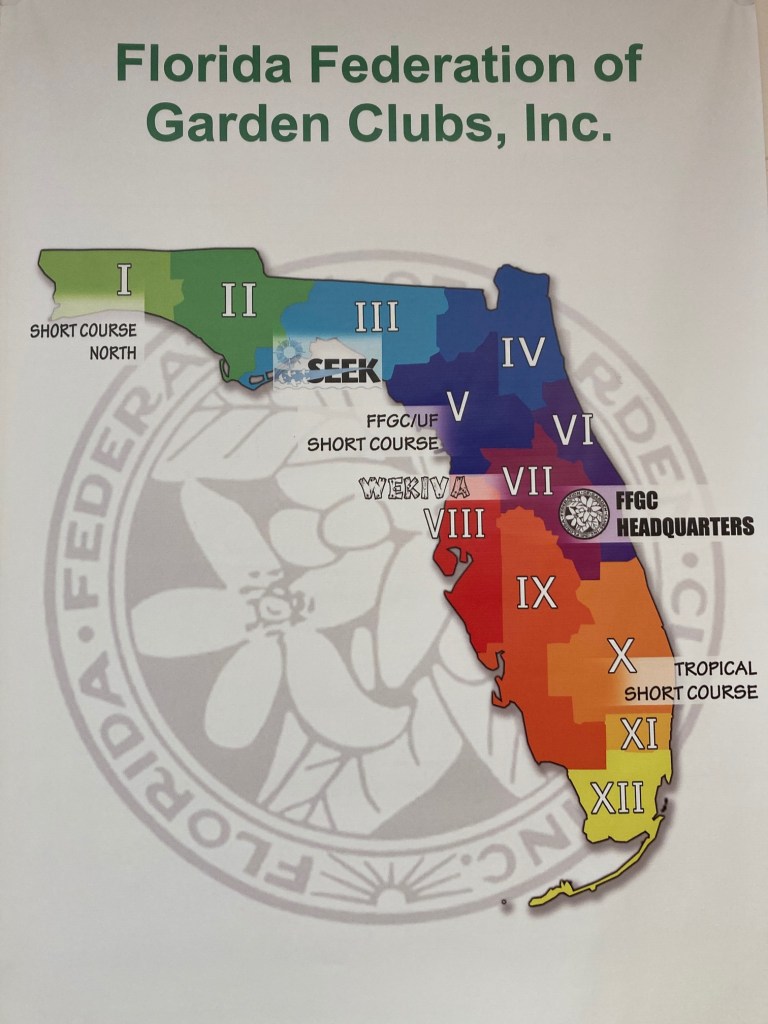
Florida can be broken into three growing regions: North, Central, & South. Each has a slightly different climate (mainly depending possibility of freezing temperatures).
Florida Federation District Map
January-May
The spring growing season is the time of year to finish the last bit of the Winter harvest (mainly leafy herbs and veggies) & begin the process of planting fruiting plants. The Spring season begins with the occurrence of the LAST FROST. This can be as late as April 15th in North Florida or as early as January in South Florida. Central Florida tends have their last frost around early to mid March. Mother Nature can be unpredictable though, so each year is always unique.
Spring is the Opportunity to grow the largest diversity of edible plants in the Florida Garden. Everything from leafy veggies, to mainly fruiting plants will populate the garden.
How long does Florida’s Spring Growing Season last?
The Spring growing Season is sandwiched between the coldest temperatures of the Florida Winter (which may or may not be freezing temperatures) and the ever-increasing Summer Heat.
On Average: the Spring Growing runs February (Last Frost depending on location in Florida) through May.
More Specifically: North Florida is normally the end of March through June. Central Florida March through May. South Florida December or January through April or May.
Summer
May-September
The hallmark of Florida’s Summer growing season are humid heat and almost daily rains. Summer tends to be too hot for many of the Spring Plants to thrive, but many fruiting plants started during Spring can be harvested into the Summer.
There are two major keys to growing a successful Summer Garden in Florida; growing the garden in Morning Sun & Afternoon Shade and making sure that plants are well-watered. The Sun during the Summer time is very intense, in fact too intense for many plants. It is recommended for the novice, especially during the Summer, to emphasize container gardening. This will give the gardener the ability to move plants around into less sunny or more sunny spots that the plants may find more suitable. Pay careful attention to what the plants are telling you, if they become droopy, while having been well-watered, this is a sign that they need to be in more shade and less sun.
Summer being such a sweltering season in much of the state, make sure that the plants are getting enough water. Signs that need water may include: wilting, droopy appearance, dusty soil (not moist to the touch, etc. Due to the excessive heat it can not be overly emphasized how critical careful attention to regular watering of the garden can be.
How long does Florida’s Summer Growing Season last?
On Average: The Summer growing season typically lasts May through September.
More Specifically: North Florida is normally June through September. Central Florida runs Mid-May through Early October. South Florida typically begins in late April and can run as late as November.
Winter
September-March
Florida’s Winter Growing Season runs between the slow cooling-off of the Fall through the end of Winter. This season is best suited for growing leafy veggies & herbs. Seeds can be started between Late Summer and into the Fall (September to Early December).
Winter tends to be a dry season in Florida, rainfall is not as common as the Summer Season. Make sure to keep leafy Veggies well-watered and partial to full sun are acceptable during the Winter Season. The cooler it becomes, the more acceptable sun exposure becomes for the garden.
As the weather cools, the bugs and pests become less active. Think of temperature as a dial, the warmer it is, the more active bugs (leaf mites, aphids, etc) become.
How long does Florida’s Winter Growing Season last?
On Average: The Winter growing season typically lasts September through March.
More Specifically: North Florida is normally September through March. Central Florida runs Mid-September through March. South Florida typically begins in late October and can run as late as February.





 Deltona Garden Community